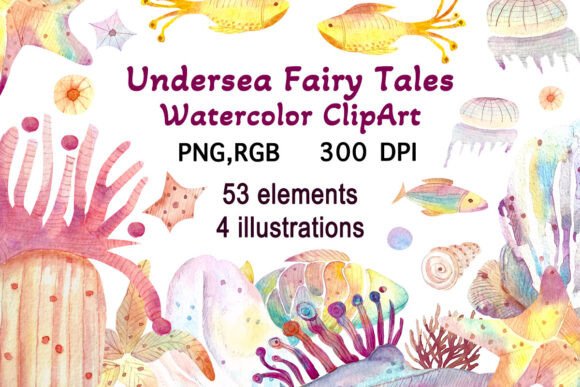
Undersea Fairy Tale Watercolor ClipArt: A Practical Evaluation
Digital creators and crafters often seek assets that balance artistic charm with technical versatility. The Undersea Fairy Tale Watercolor ClipArt collection represents a specific niche within the digital illustration market, offering hand-painted elements designed for various creative applications. This article evaluates the nature of this resource, its technical specifications, and the scenarios in which it serves as an effective tool for designers and hobbyists alike.
Understanding the Resource
The Undersea Fairy Tale Watercolor ClipArt is a digital download consisting of illustrations originally created using traditional watercolor techniques on paper. These physical paintings are subsequently scanned and converted into high-resolution digital files. The collection includes 53 distinct elements derived from four primary illustrations, all featuring transparent backgrounds in PNG format. Each file measures 3000×3000 pixels and maintains a resolution of 300 DPI within the RGB colorspace.
This hybrid creation process—starting with analog media and finishing with digital processing—is central to the product's identity. It preserves the organic texture, pigment variation, and soft edges characteristic of watercolor painting while providing the scalability and ease of use associated with digital assets. The collection focuses on an undersea theme, likely incorporating marine life, aquatic flora, and fantasy elements suitable for storytelling or decorative purposes.
Reasons for Interest
Creatives may be drawn to this specific clipart set for several practical reasons. First, the hand-painted aesthetic offers a level of uniqueness that vector graphics or stock photography often lack. In a digital landscape saturated with clean lines and perfect gradients, the imperfections of watercolor can add warmth and character to a design project.
Secondly, the versatility of the included elements makes them suitable for a wide range of mediums. The description highlights potential uses including greeting cards, wrapping paper, book covers, textiles, ceramics, and tiles. For individuals engaged in print-on-demand businesses, such as creating designs for mugs, tote bags, or phone cases, having high-resolution files (300 DPI) is a critical requirement for professional-quality output.
Furthermore, the inclusion of 53 separate elements allows for significant customization. Rather than being limited to a single static image, users can rearrange components to create unique compositions. This modularity is particularly valuable for scrapbooking, planner cover design, and web layouts where specific placement of elements is necessary.
Benefits and Technical Considerations
The primary benefit of the Undersea Fairy Tale Watercolor ClipArt lies in its resolution and format. At 3000×3000 pixels and 300 DPI, these files are robust enough for large-format printing without significant loss of quality. The PNG format with a transparent background simplifies the integration of these images into other software, eliminating the need for time-consuming background removal processes.
However, there are tradeoffs to consider regarding the file type. Because the images are raster-based (scanned photographs of paintings), they cannot be scaled infinitely like vector graphics (SVG or EPS). While 3000 pixels is substantial, extremely large prints or aggressive zooming could eventually reveal pixelation. Users planning to print on very large banners or billboards should verify if the dimensions meet their specific scale requirements.
Another consideration is the color profile. The files are provided in RGB colorspace, which is standard for screens and digital displays. However, many professional printing services utilize CMYK. While most modern printers can convert RGB to CMYK automatically, slight color shifts may occur during the conversion process. Creators working on projects with strict color matching requirements should test print samples before committing to a full production run.
Ideal Use Cases
This asset collection is a strong fit for specific types of projects. It is particularly well-suited for:
- Small Business Product Design: Creating patterns or focal points for merchandise like t-shirts, mugs, and tote bags where a whimsical, artistic style is desired.
- Paper Crafts: Designing greeting cards, invitations, and digital scrapbook pages where the organic feel of watercolor complements the tactile nature of paper goods.
- Web and Blog Design: Using individual elements as decorative accents, headers, or icons to enhance the visual appeal of websites without overwhelming the content.
- DIY Projects: Personalizing planners, dashboards, or party backdrops where custom imagery is needed but commissioning original art is not feasible.
In these scenarios, the combination of high resolution and artistic texture provides immediate value, saving the user time and effort in sourcing or creating similar imagery from scratch.
When to Consider Alternatives
Despite its strengths, the Undersea Fairy Tale Watercolor ClipArt may not be the optimal choice for every situation. If a project requires precise geometric shapes, sharp lines, or the ability to resize the image to any dimension without quality loss, vector-based clipart would be a superior alternative. Vector files are essential for logo design or signage that requires extreme scaling.
Additionally, if a creator needs a cohesive, seamless pattern rather than individual elements, a dedicated pattern tile might be more efficient. While the 53 elements here can be arranged to form a pattern, pre-made seamless repeats save time in the layout phase.
Users who require specific mockups or scene compositions should also note that this download does not include preview scenes or mockups. Those seeking ready-to-use presentation materials for client pitches might need to source those separately.
Decision-Making Insights
Before acquiring the Undersea Fairy Tale Watercolor ClipArt, potential buyers should evaluate their specific workflow needs. Key questions to ask include:
- What is the final output size? Ensure the 3000×3000 pixel dimensions are sufficient for the intended print size at 300 DPI.
- Is the color shift acceptable? Understand that monitor settings vary, and RGB-to-CMYK conversion may alter hues slightly.
- Do I need vectors? If the project demands infinite scalability, look for vector alternatives instead.
- How much editing is required? Determine if you have the skills to composite the 53 elements into your desired layout, as the files are raw assets, not finished designs.
By weighing these factors, creators can determine if this hand-painted digital collection aligns with their goals. For those seeking a charming, high-resolution resource for moderate-scale printing and digital design, it offers a practical solution that bridges the gap between traditional art and modern utility.